Digital Contact Sheet. Photographic Estate of Richard Kitschigin
2020 © Thomas GadeAccess: December 2017
Digital Contact Sheets
Reviewing the collection was difficult because the individual negatives were stored in separate glassine sleeves. For this reason, they were transferred film by film into polypropylene sheets with twelve pockets for individual 6×6 negatives.An Epson Expression 10000XL flatbed scanner with a transparency unit for formats up to DIN A3 made it possible to scan these transparent sleeves with the negatives and print files that resemble traditional darkroom contact sheets.
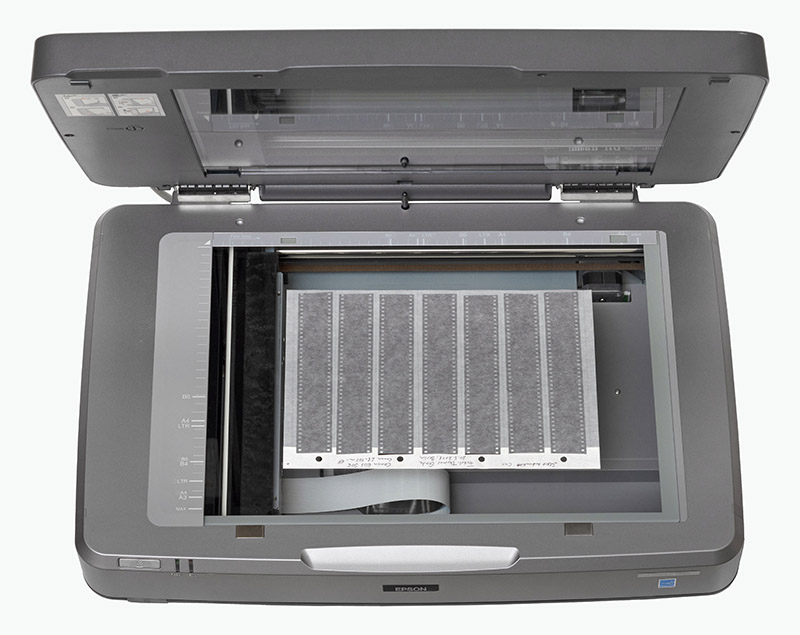
The Epson Expression 10000XL has a large scanning surface on which the fileable film sleeve for DIN A4 binders can be comfortably placed in the center. There is still plenty of space around it. Unfortunately, inexpensive DIN A4 scanners do not offer this convenience. The large Epson Expression 10000XL is excellent for producing high resolution digital contact sheets. For better illustration, a glassine sleeve with seven 35mm strips was placed on the glass, which is better visible than the transparent polypropylene sleeves with the 6×6 negatives.
The complete sleeve with twelve 6×6 negatives is scanned on an Epson Expression 10000XL at 2400 dpi. This means there is only one file per film. The scanner is so good that its real maximum resolution corresponds to 2050 dpi. Thanks to autofocus, sharpness is always perfect. The PET sleeves from Hama produce hardly any Newton rings and affect image quality only minimally.
Fortunately, this means that the individual photos can be enlarged from the file, and medium format images are easily suitable for a proper DIN A3 print. The three images demonstrate this. The first shows a digital contact sheet, then a single enlarged photo from it, and finally a cropped detail from the same photo. In the original—i.e., not reduced for Facebook—the images are, of course, much more detailed.
This convenient method of quickly enlarging a selection with an inkjet printer is something the conventional contact sheet does not offer me. In addition, new contact sheets can easily be printed from the files at any time if the originals become damaged or if multiple sets need to be distributed.
The high resolution also encourages individual tonal corrections for images of varying density, or for high contrast and low contrast images on a single sheet. For this reason, some digital contact sheets ultimately look better than conventional ones from the wet darkroom.

Digital contact sheet from a 120 roll film with twelve exposures in 6×6 format. Richard Kitschigin photographed a young woman in an improvised studio.
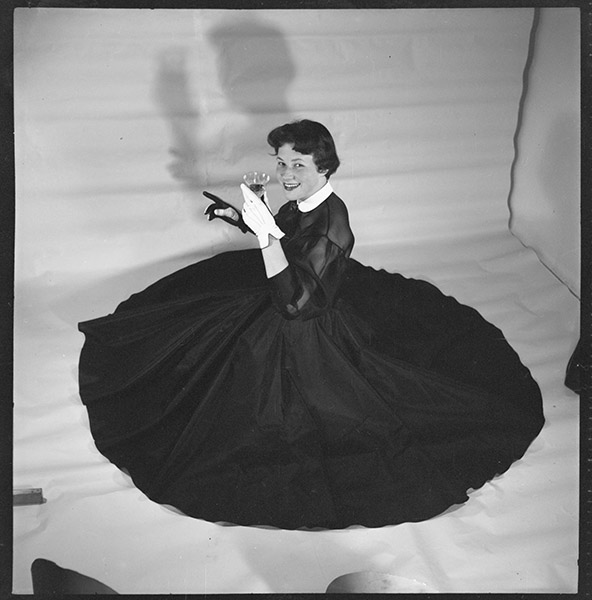
Here, a 6×6 photo was cropped from the digital contact sheet. The quality is remarkable, as the following detail from the same image shows.

The cropped detail shows that the digital contact sheet, thanks to the scanner’s high resolution, already allows good prints of individual medium‑format images. It is therefore not necessary to scan all images individually. This is reserved for particularly good motifs when a specific use is intended.
Back: Page 2
The content on this website was originally written in German. Only later were longer articles
translated into English to reach a more global audience. Hopefully, the supporting AI didn’t
introduce too many errors in the process. For pages that primarily showcase images, however,
the additional effort of creating duplicate versions in two languages is hardly worthwhile.