Cataloguing the Photographic Estate of Richard Kitschigin
2020 © Thomas GadeAccess: December 2017
Medium Format Black-and-White Negatives (6x6)
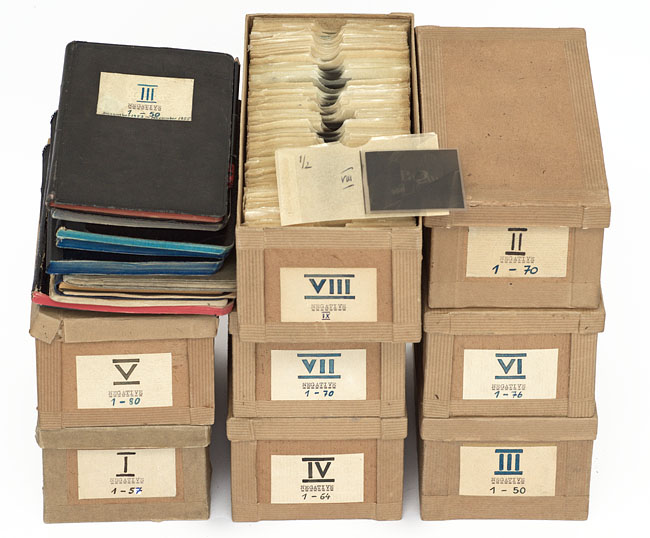
The collection contains 8 boxes filled with medium format (6×6) black-and-white negatives, each stored in individual glassine sleeves with handwritten notes describing the image. Labels such as "1–50" indicate that 50 medium format films are stored in one box. Kitschigin kept around 12 exposures per film. Altogether, the boxes likely contain around 6000 negatives.
Notebooks with Detailed Information About the Photos
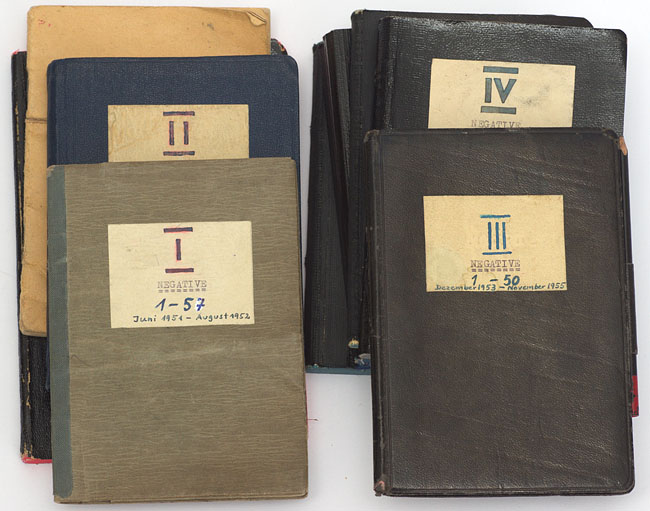
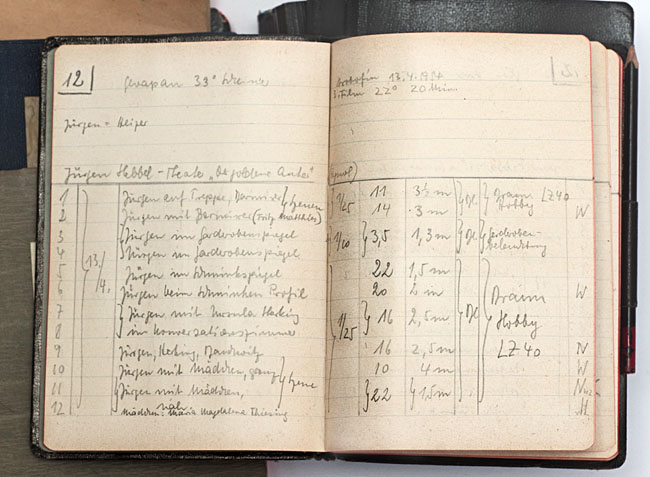
The notebooks were of good quality, but they had suffered over several decades due to use by the photographer and probably other influences. While reviewing the images, the notebooks were more in the way on the desk than they were helpful. For this reason, all of them were scanned. I refrained from cutting off their spines to use a fast and convenient document scanner with an automatic feeder, because the entries extended across both open pages. The originals were also meant to be preserved. Therefore, the scanning was done manually with an older Epson Perfection 3200 Photo flatbed scanner. The opened notebooks had to be pressed firmly onto the glass. This put considerable mechanical stress on their bindings, but it was unavoidable to achieve good scan quality. The notebooks survived this procedure surprisingly well.
Notebooks as PDF Files
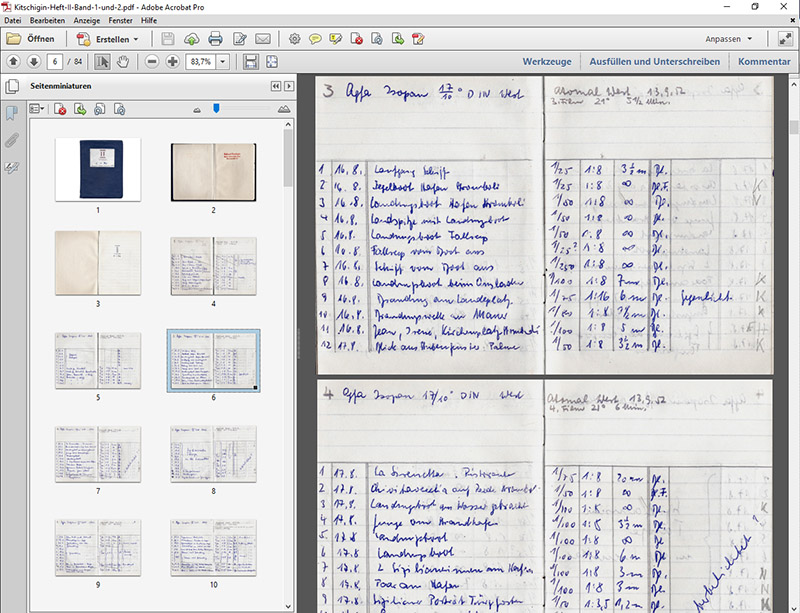
Using tonal corrections afterwards, the legibility of the writing on the slightly yellowed pages could be improved. Pencil entries in particular were difficult to read on yellowed paper, but this could be enhanced digitally. Afterwards, it proved to be a great relief for further work to be able to quickly open the notebooks on the computer instead of digging out the originals and flipping through them.Looking ahead, the files make it possible to print the notes on the back of the corresponding contact sheets, so that the specific image descriptions are immediately available when browsing the negative archive. The files also make it easier to involve others in the work digitally.
Each notebook exists as a high‑quality PDF file. In addition, the original files of the individual pages are also preserved. They each carry the same name as the film’s signature, for example "Kitschigin‑VII‑31". This file clearly belongs to film no. 31 from the stack labeled VII.
Handmade Boxes for Archiving
Richard Kitschigin crafted cardboard boxes to store his 6×6 negatives. The labels on the boxes carried Roman numerals from I to VIII, corresponding to the Roman numerals on the notebooks. All associated negatives were individually packed in glassine sleeves and stored in exact numerical order inside these boxes. His storage system made it possible to quickly find any negative based on the entries in the notebooks and the numbering of all images.The boxes varied in length. Apparently, Kitschigin built them precisely to match the length of the stack of negatives belonging to each Roman numeral. One can therefore assume that the boxes were made only after completing all the images associated with a given numeral. The original glassine sleeves had yellowed, and the cardboard boxes had partially torn and become brittle.
Between 2019 and 2021, all negatives were transferred into polypropylene archival sleeves from Hama. The old glassine sleeves and boxes could then be discarded. However, it was appealing to preserve some of these boxes. To do so, they had to be re‑glued in places and reinforced for durability.
The idea came to me while working with epoxy resin. A usable leftover remained in the mixing cup, but it had to be used quickly before the resin hardened. I coated all sides of a cardboard box with it. The result was unattractive. In some areas, the resin soaked into the paper and left a rough surface, while in others it remained smooth. The material became very dark, as if soaked with water. Good results, however, could be achieved if the cardboard was first coated twice with wood glue and only then given a thin layer of resin.
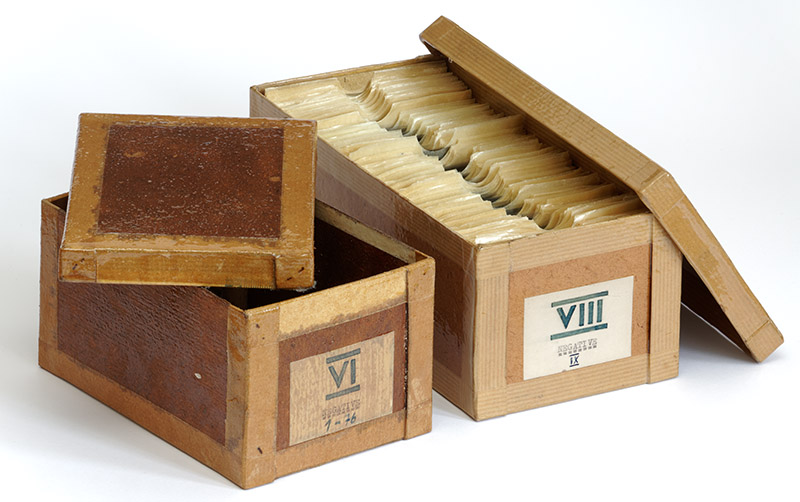
Left: Unattractive surface after applying epoxy resin.
Right: Better result after two coats of wood glue followed by a thin layer of epoxy resin.
Wood glue and epoxy resin contain no solvents, and they do not release plasticizers over time. After the resin has cured, photographic material can be stored in such containers, although they are no longer breathable. However, they protect the contents very well if, for example, a cup of coffee spills nearby, as they shield against moisture as effectively as a plastic container.
New Polypropylene Negative Sleeves
Between 2019 and 2021, all negatives were transferred into polypropylene archival sleeves from Hama. The types Hama ProArchiv 2038 (25 pieces) and 2039 (100 pieces) each had twelve pockets for 6×6 negatives or slides. Since a 120 roll film, which Kitschigin used, contains exactly twelve 6×6 exposures, these sleeves were ideal for grouping the negatives film by film in transparent, archival‑safe material.Unfortunately, this material from the Hama ProArchiv series was no longer available new, as it had been discontinued. The sleeves were gradually acquired via eBay and eBay‑Kleinanzeigen. The old glassine sleeves and boxes could then be discarded. However, it was appealing to preserve at least two of these boxes. They therefore had to be stabilized and conserved in some way.
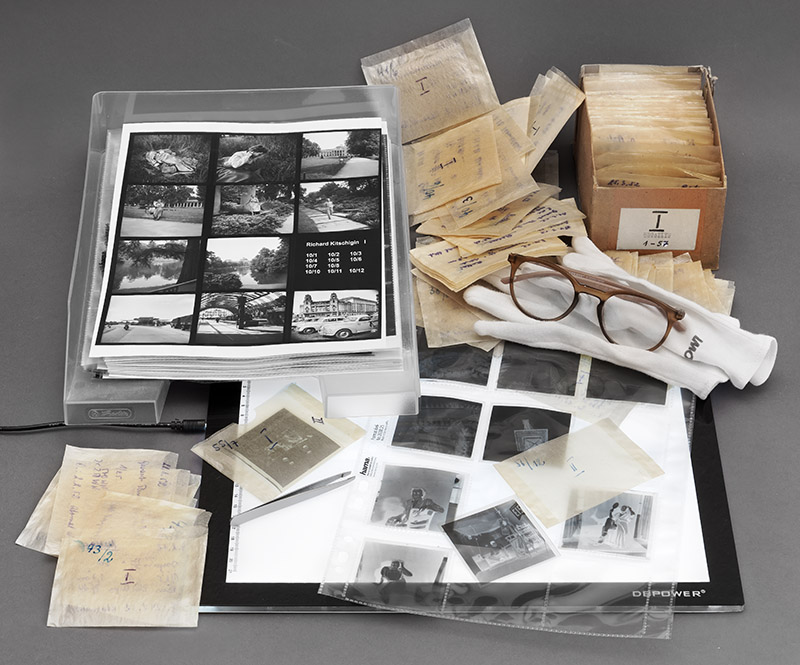
Transferring the negatives from the old sleeves into new transparent polypropylene sleeves. They allow better viewing on the light table and the creation of contact sheets. The clear labeling and assignment to the entries in the notebooks was preserved.
Back: Page 1
Next: Page 3
The content on this website was originally written in German. Only later were longer articles
translated into English to reach a more global audience. Hopefully, the supporting AI didn’t
introduce too many errors in the process. For pages that primarily showcase images, however,
the additional effort of creating duplicate versions in two languages is hardly worthwhile.